 © 2023 / 2024 - QHIQ
Diving into the Quantum Abyss
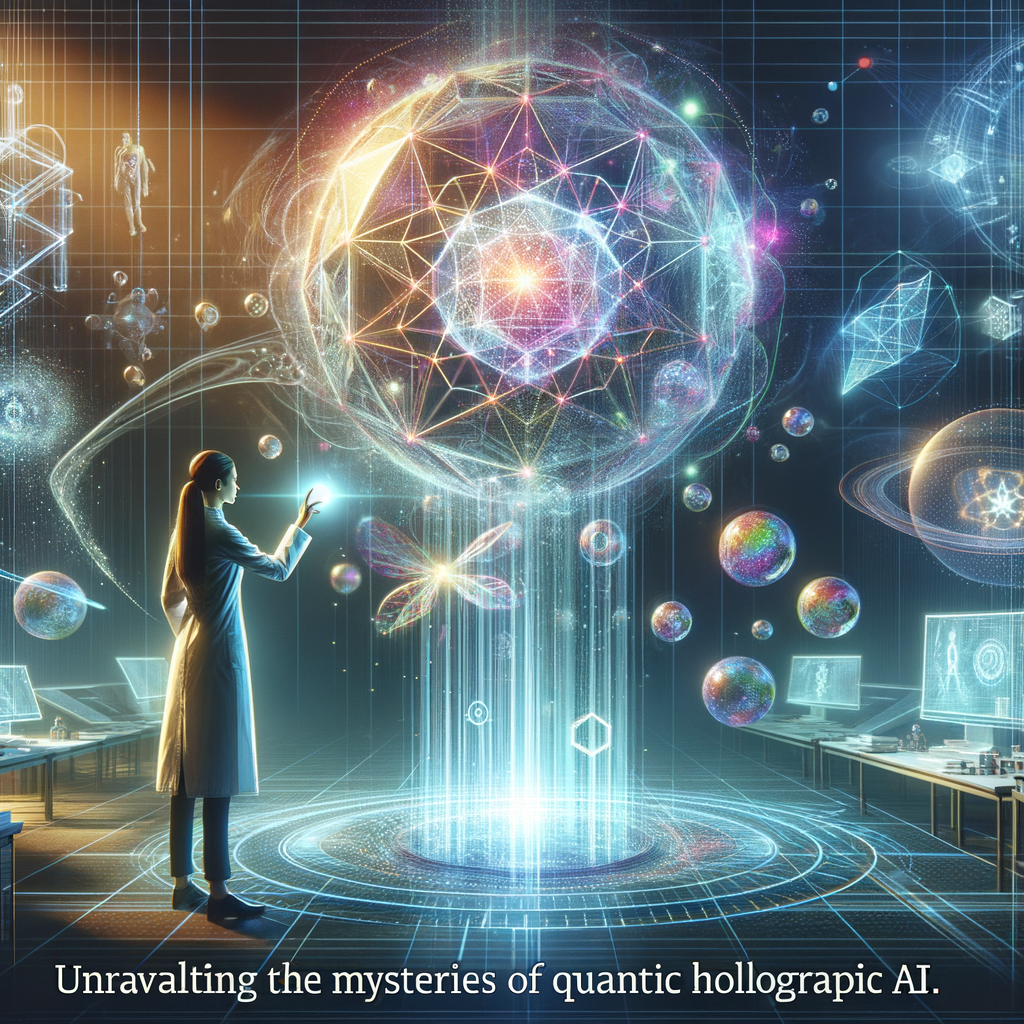
Quantic holographic artificial intelligence (QHAI) is heralding a new era in computational paradigms, where the nuances of quantum mechanics intertwine seamlessly with holographic principles to create unprecedented opportunities. This fusion allows for the representation of vast amounts of data in compact quantum states, leveraging phenomena such as superposition and entanglement to revolutionize AI capabilities. Unlike classical systems, QHAI can potentially reconstruct information with hyper-efficiency, yielding exponential increases in both processing power and storage capabilities.
Surface the Computational Potential
Recent advancements in QHAI have led to the creation of q-bits that utilize holographic projections, ultimately expanding the bandwidth of quantic processors. Researchers have developed algorithms that operationalize these q-bits through intricate quantum-state manipulations. By applying holography, where each quantum state retains a holographic imprint, AI can perform calculations that were once thought beyond reach. This not only transforms computational strategies but also enhances machine learning models with higher dimensions of data understanding.
class QuantumQubit:
   def __init__(self, state: 'quantum_state', holography: 'holographic_principle'):
      self.state = state
      self.holography = holography
   def manipulate_state(self, operation: 'quantum_operation'):
      updated_state = apply_qubit_operation(self.state, operation)
      return updated_state
Entangled Challenges and Infrastructure Needs
As thrilling as QHAI sounds, it is not without its formidable set of challenges. Maintaining coherence in quantum systems while integrating them with classical computational architectures presents significant hurdles. Noise and decoherence can disrupt the delicate balance of quantum states, causing potential information loss. Furthermore, scaling these systems while ensuring consistency across expansive datasets demands both innovative hardware solutions and sophisticated error-correction algorithms.
def maintain_coherence(state: 'quantum_state', time: float) -> bool:
   try:
      coherence_status = coherence_check(state, time)
   except QuantumDecoherenceError:
      coherence_status = False
   return coherence_status
Quantum Leap for Startups
Managing a startup like Quantum Holographic IQ within the realm of emerging quantum technologies involves navigating a landscape laden with both promise and peril. Startups must adeptly balance investment in bleeding-edge R&D while crafting scalable business models poised for a market that is just beginning to grasp the transformative potential of QHAI. Collaborative synergy with academia and large-scale tech enterprises can offer pathways to mitigate risk and accelerate technological maturation.
The Path Forward: Futuristic Horizons
Looking ahead, the horizon for QHAI is laden with possibilities stretching towards the uncharted domain of self-evolving AI systems that learn at quantum speed. The amalgamation of machine learning's analytical prowess with quantum's parallelism could culminate in AI systems capable of simulating increasingly complex real-world phenomena. As the academy, industry, and startups converge upon these frontiers, the quantum future holds the promise of catalyzing breakthroughs once confined to the realm of science fiction.
def evolve_quantum_ai_system(ai_system: 'QuantumAI', learning_rate: float):
   while not ai_system.has_converged():
      ai_system.update(learning_rate)
   return ai_system