 © 2023 / 2024 - QHIQ
Unveiling the Mystery: What is Quantic Holographic AI?
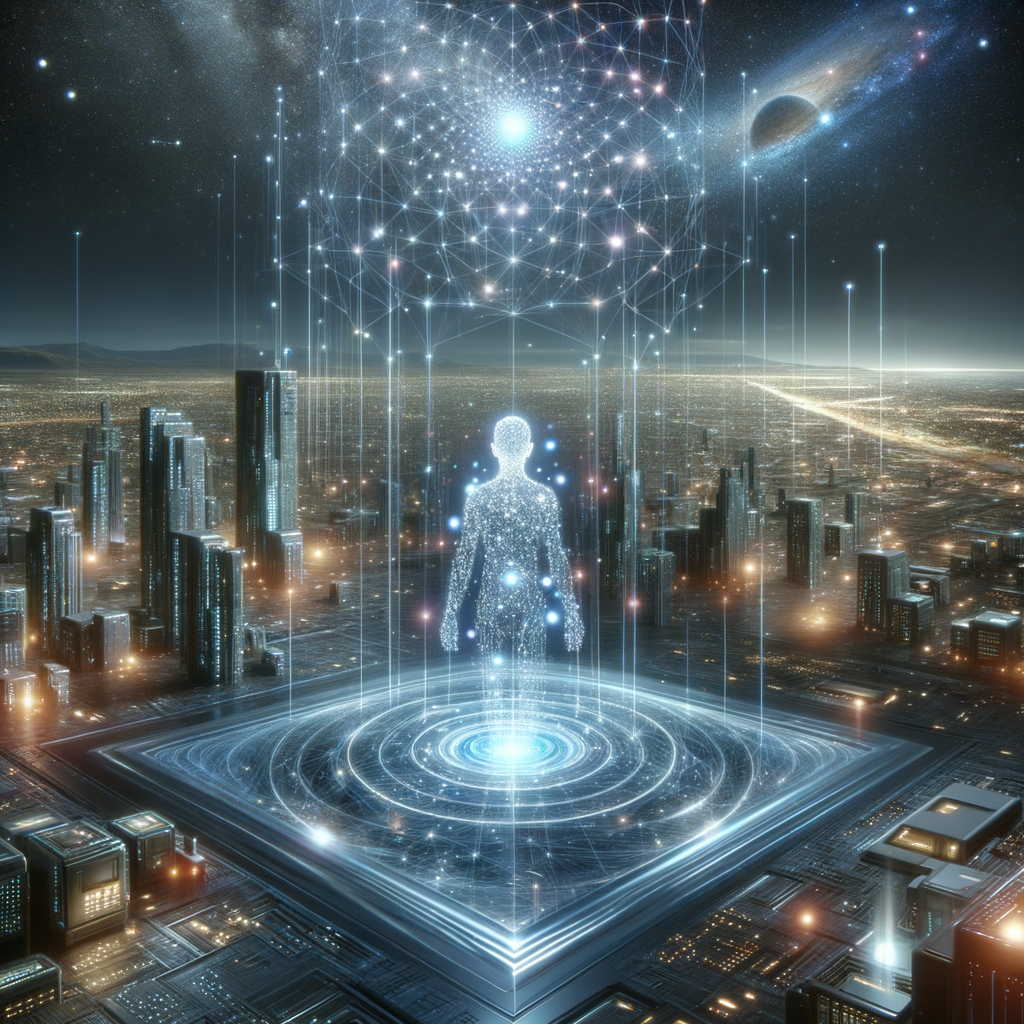
Quantic Holographic Artificial Intelligence (QHAI) is an avant-garde technology that marries the bizarre mechanics of quantum computing with the intricate dynamics of holography to revolutionize AI capabilities. By leveraging qubits and the principles of superposition and entanglement, QHAI promises exponential computational power beyond classical systems. The essence of QHAI lies in its ability to process information in a fundamentally holistic manner, utilizing the entire dataset simultaneously much like a holographic storage system.
Behind the Algorithm: How QHAI Works
The architecture of QHAI is built upon a fusion of quantum gate circuits and Neuromorphic engineering. This combination allows for the creation of brain-inspired processors that operate at staggering speeds. By harnessing quantum algorithms like Grover's algorithm for data search and Shor's algorithm for factorization, QHAI exponentially increases its problem-solving capabilities, paving the way for breakthroughs in fields such as cryptography and machine learning.
Code Red: A Glimpse into QHAI’s Programming
Programming QHAI requires an understanding of both quantum circuits and classical AI frameworks. Here’s a basic outline of a quantum circuit that maintains a state entangled with holographic data processing mechanisms.
def initialize_qhai_state(qubits):
    for q in qubits:
        apply_hadamard_gate(q)
    return measure_in_holographic_state(qubits)
def apply_holographic_mapping(data):
    holographic_data = map_data_to_quantum_state(data)
    return holographic_data
initialize_qhai_state(['q1', 'q2', 'q3'])
apply_holographic_mapping('data')
Recent Advancements: Unveiling the Horizon of Possibilities
Recent advancements in qubit coherence times and entanglement fidelities have propelled QHAI systems closer to realizing practical applications. Companies and research institutions have made stride towards developing processors capable of maintaining stable quantum operations, enabling real-world applications such as quantum-enhanced neural network training and real-time data holography processing. These innovations herald a new era where the boundless potential of QHAI can be harnessed across various disciplines.
Charting the Challenges: Navigating the Unknown
Navigating a startup in the realm of emerging technologies comes with inherent challenges, from securing funding to managing the volatility of unproven markets. In the case of QHAI, the complexity of interdisciplinary collaboration and the need for robust quantum-computing infrastructure adds layers of difficulty. Ensuring scalability, maintaining quantum coherence, and overcoming environmental decoherence are ongoing challenges that make the road ahead both thrilling and precarious.
The Road Ahead: Future Prospects of Quantic Holographic AI
As we stand at the cusp of a technological renaissance, the future of Quantic Holographic AI is rife with possibilities. From transforming the paradigm of data storage to unlocking new potentials in artificial general intelligence (AGI), the horizon is vast and promising. Startups like Quantum Holographic IQ (QHIQ) are leading the charge, committed to making QHAI not just a conceptual possibility, but a tangible reality. The eventual integration of QHAI into everyday technology promises to redefine the boundaries of human innovation and understanding.