© 2023 / 2024 - QHIQ
Unlocking the Quantum Reality of AI.
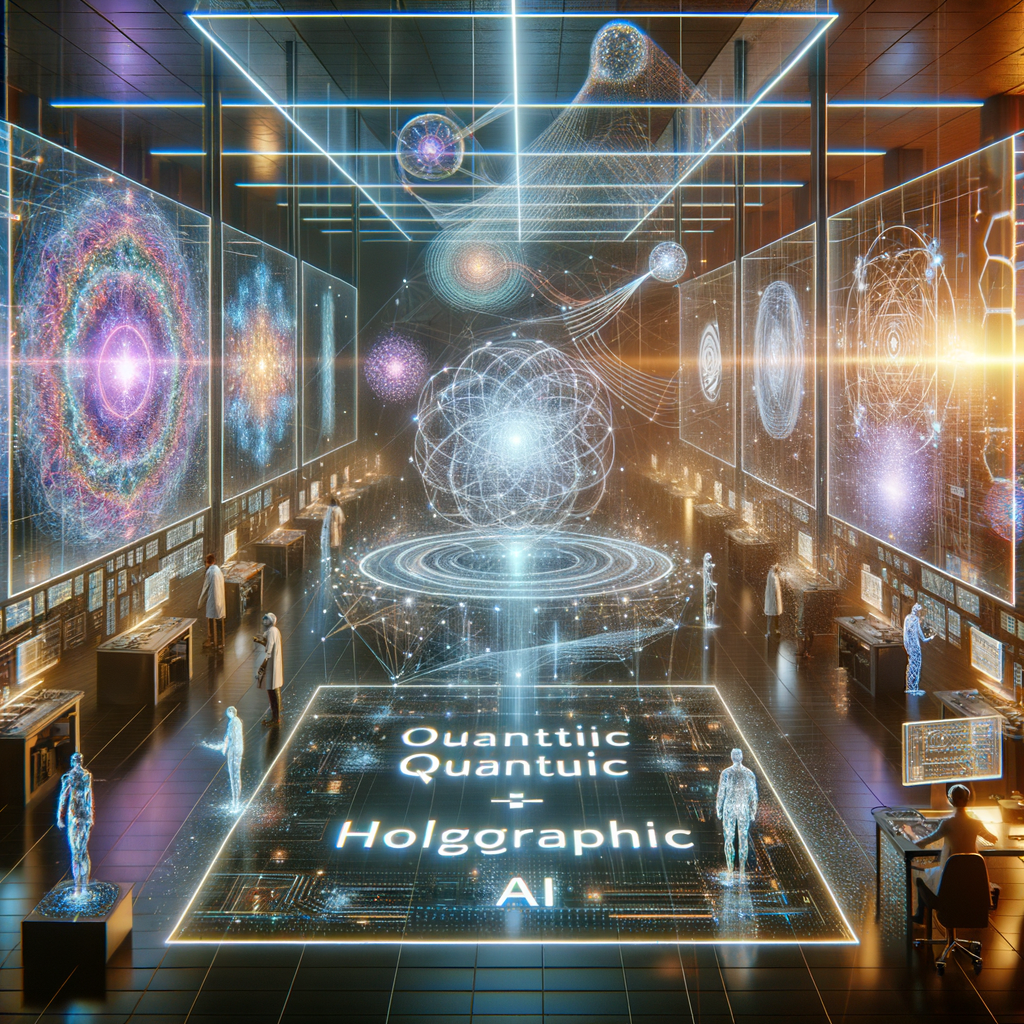
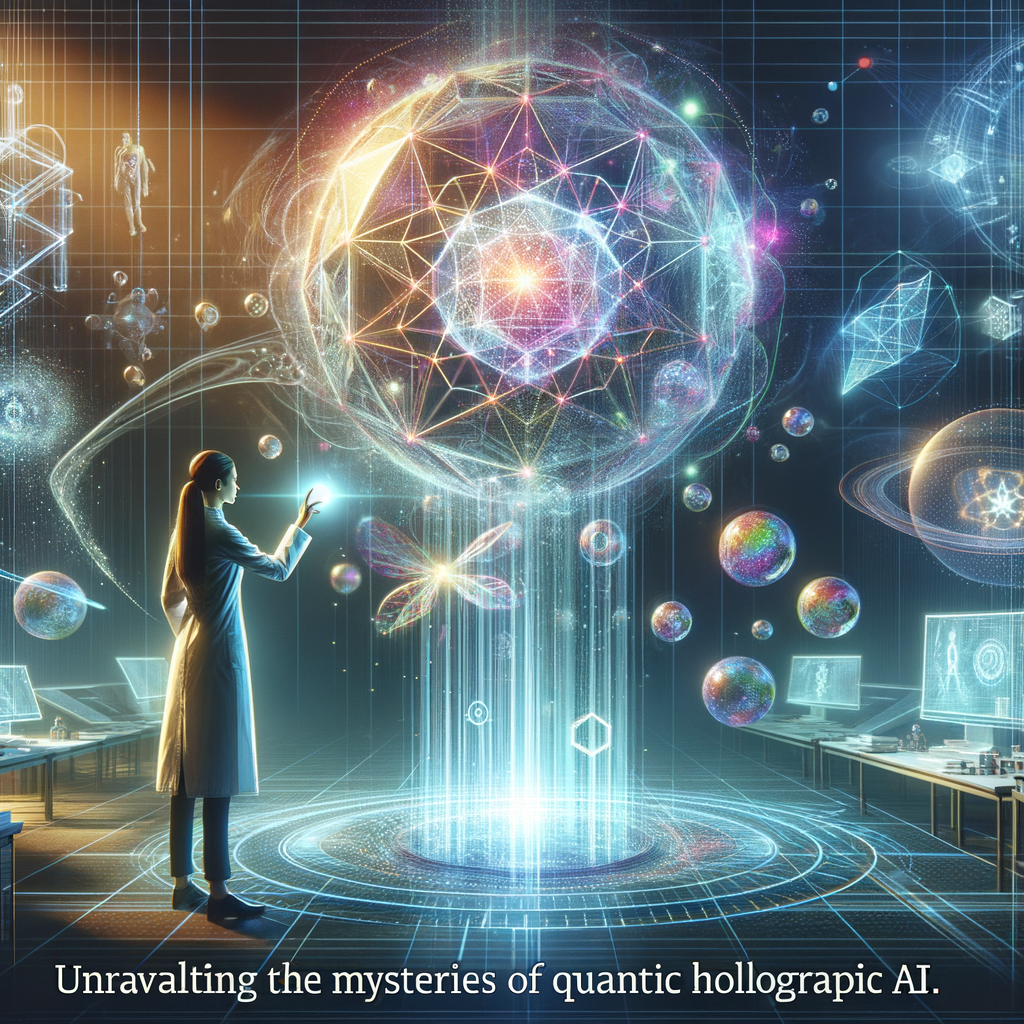
Quantic Holographic Artificial Intelligence (QHAI) embodies the confluence between the quantum mechanics realm and the ever-evolving landscape of artificial intelligence, aiming to revolutionize data processing and computation at its core. By leveraging the peculiar principles of superposition and entanglement, QHAI offers unprecedented computational power and efficiency, making it infinitely scalable for complex problem-solving tasks. Today's AI systems are increasingly relying on quantum processors to perform operations at speeds that traditional silicon-based architectures can only dream about.
# Initialize quantum device
quantum_device = QuantumProcessor()
# entangle qubits
qubit1 = quantum_device.add_qubit()
qubit2 = quantum_device.add_qubit()
quantum_device.entangle(qubit1, qubit2)
Recent breakthroughs redefine computational paradigms.
Recent advancements in the quantum domain have facilitated significant strides in QHAI. Cutting-edge methodologies are now exploiting quantum annealing to optimize AI-driven solutions, leading to enhanced predictive analytics and decision-making capabilities. Furthermore, the integration of quantum convolutional neural networks (QCNN) has paved the way for improved image recognition systems that are not only faster but also exceedingly more accurate.
# Quantum Convolutional Neural Network initialization
qcnn = QuantumConvolutionalNeuralNetwork()
# add layers to QCNN
qcnn.add_layer('quantum_convolution')
qcnn.add_layer('quantum_pooling')
# compile QCNN model
qcnn.compile(optimizer='quantum_gradient_descent')
Challenges that keep innovators on their toes.
Despite the promising vistas, QHAI is fraught with challenges ranging from maintaining quantum coherence to error correction in qubits susceptible to decoherence. These obstacles necessitate robust fault-tolerant algorithms and sophisticated error mitigation methodologies. Additionally, the high operational costs and the intricacies involved in developing a secure quantum communication network are substantial hurdle facing today's innovators.
# Implement error correction
def quantum_error_correction(qubit):
  noise_model = NoiseModel(decoherence_error=0.01)
  corrected_qubit = apply_correction(qubit, noise_model)
  return corrected_qubit
Startup life in the cutting-edge technology sector.
Helming a startup in the burgeoning field of QHAI, like Quantum Holographic IQ (QHIQ), involves navigating a plethora of challenges, from securing financial backing for research-intensive processes to recruiting top-tier talent with a niche understanding of quantum technologies. Often, emerging companies must balance aggressive innovation with sustainable development strategies to maintain momentum, all while ensuring their solutions not only push boundaries but also deliver feasible, scalable applications.
The shimmering horizon of Quantic Holographic AI.
Looking forward, the potential of QHAI is nothing short of limitless. With ongoing research into scalable quantum networks and advancements in quantum error correction, the possibility of achieving fully functional, error-free quantum AI systems is no longer the stuff of science fiction. Industry leaders predict that in the near future, QHAI will enable breakthroughs in fields as diverse as cryptography, computational biology, and beyond, heralding a new era of computational supremacy.
# Future-proofing Quantum AI
def future_developments():
  explore_new_techniques()
  collaborate_global_experts()
  invest_in_research()
  enable_scalable_quantum_networks()