 © 2023 / 2024 - QHIQ
The Dawn of Quantum Holographic Intelligence Revolutionizes AI.
Quantum Holographic Artificial Intelligence (QHAI), an emerging paradigm, promises to revolutionize the landscape of machine learning and artificial cognition by harnessing the principles of quantum mechanics and holography. By leveraging superposition, entanglement, and interference, QHAI seeks to solve problems that are currently intractable for classical computing methodologies. This innovative approach not only enhances computational speed and efficiency but also facilitates the development of AI models with unprecedented accuracy and scalability, thus enabling breakthroughs across diverse sectors such as finance, healthcare, and autonomous systems.
Key Concepts: Bridging Quantum Mechanics with Holographic Intelligence.
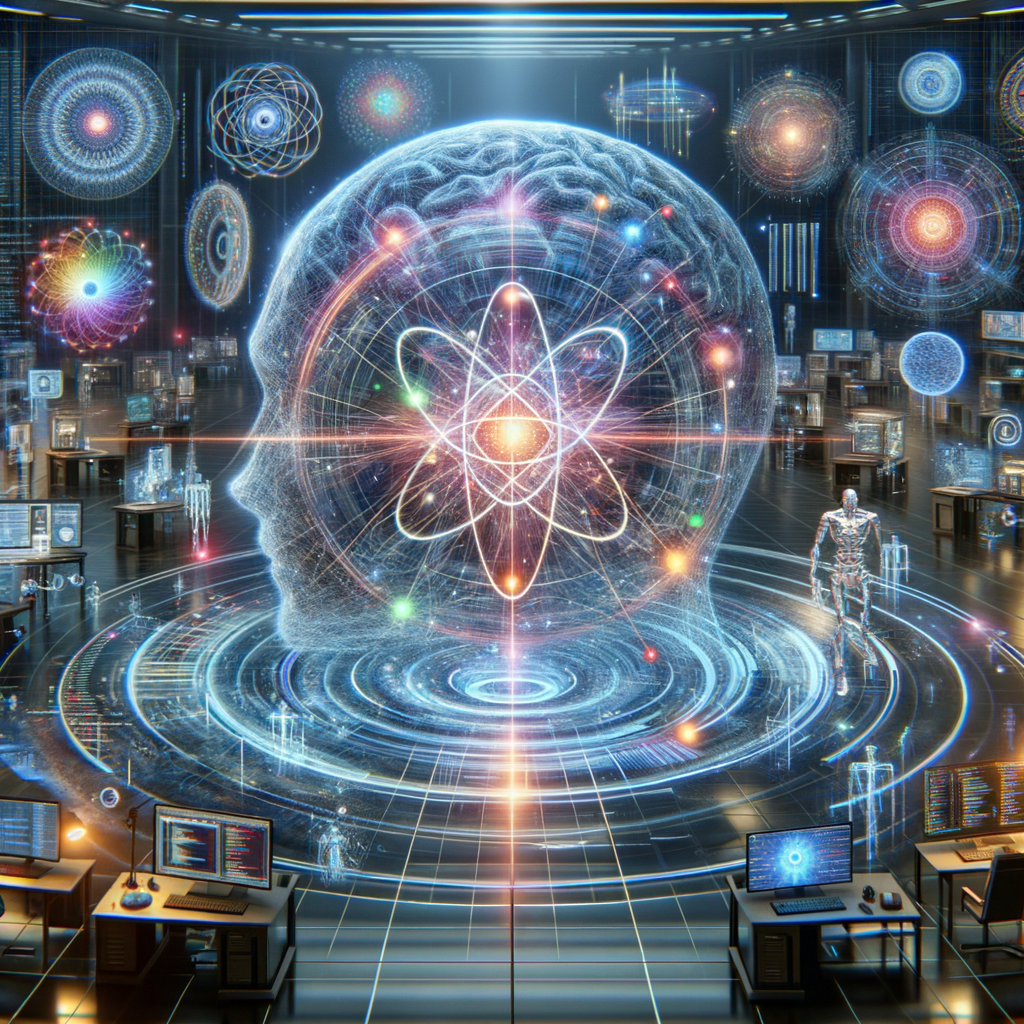
At the core of QHAI lies the synthesis of quantum computation with holographic systems, creating an ecosystem where quantum bits (qubits) are manipulated within a holographic framework. This paradigm enables the realization of highly complex algorithms capable of processing and storing vast amounts of information in an intricate, interconnected web. One of the groundbreaking techniques involves the use of quantum neural networks (QNNs) that mimic both the wave-particle duality and coherence of qubits, substantially enhancing the capabilities of neural networks beyond classical limitations.
def quantum_superposition(state1, state2):
    return (state1 + state2) / sqrt(2)

entangled_state = quantum_superposition('|0>', '|1>')
print(f"Entangled State: {entangled_state}")
Recent Advancements Propel the Frontiers of QHAI.
Recent advancements in QHAI have been marked by significant milestones, such as the development of quantum-aware holographic lenses capable of manipulating qubits in real-time. These advancements have been fundamental in optimizing the quantum Fourier transform, a critical component in the implementation of quantum algorithms, thereby enhancing processing capabilities exponentially. Notable breakthroughs include the refinement of error correction techniques, which have substantially reduced decoherence and noise, allowing for more stable and reliable quantum computations.
def quantum_fourier_transform(qbits):
    # Implementation of Quantum Fourier Transform
    n = len(qbits)
    for i in range(n):
        # Apply controlled rotation
        pass # Simplified
    return qbits
qbits = [0, 1, 0, 1]
transformed_qbits = quantum_fourier_transform(qbits)
print(f"Transformed Qubits: {transformed_qbits}")
Overcoming Challenges in the Quantum Holographic Landscape.
Despite the promising advancements, QHAI faces numerous challenges that impede its full deployment. Scalability remains a primary concern, as the transition from prototype to wide-scale implementation demands significant resources and infrastructure. Furthermore, quantum systems are inherently susceptible to environmental disturbances, leading to issues such as qubit decoherence. Addressing these challenges requires robust theoretical models and innovative engineering solutions to ensure consistency, reliability, and maintainability.
Navigating the Startup Terrain in Quantum AI Ventures.
Running a startup in the rapidly evolving field of quantum AI involves distinct challenges, from securing funding to attracting a skilled workforce. The high level of technical expertise required often necessitates collaborations with academic institutions and other tech companies. Moreover, the regulatory landscape is still evolving, adding layers of complexity to legal compliance and ethical considerations. Entrepreneurs must balance innovation with pragmatism, strategically navigating the shifting sands of technological and market dynamics.
The Future Prospects: A Quantum Leap Forward.
As we look toward the future, the potential applications of QHAI are staggering. From personalized medicine to climate modeling and beyond, the integration of quantum holography will redefine the capabilities of artificial intelligence. The collaborative efforts between researchers, industry players, and policymakers will be pivotal in driving the adoption and maturation of QHAI technologies. As these systems transcend the boundaries of current technology, they herald a new era where intelligence is not merely augmented, but fundamentally transformed to unlock a plethora of novel possibilities.