 © 2023 / 2024 - QHIQ
The Quantum Leap: Decoding the Fabric of Intelligence.
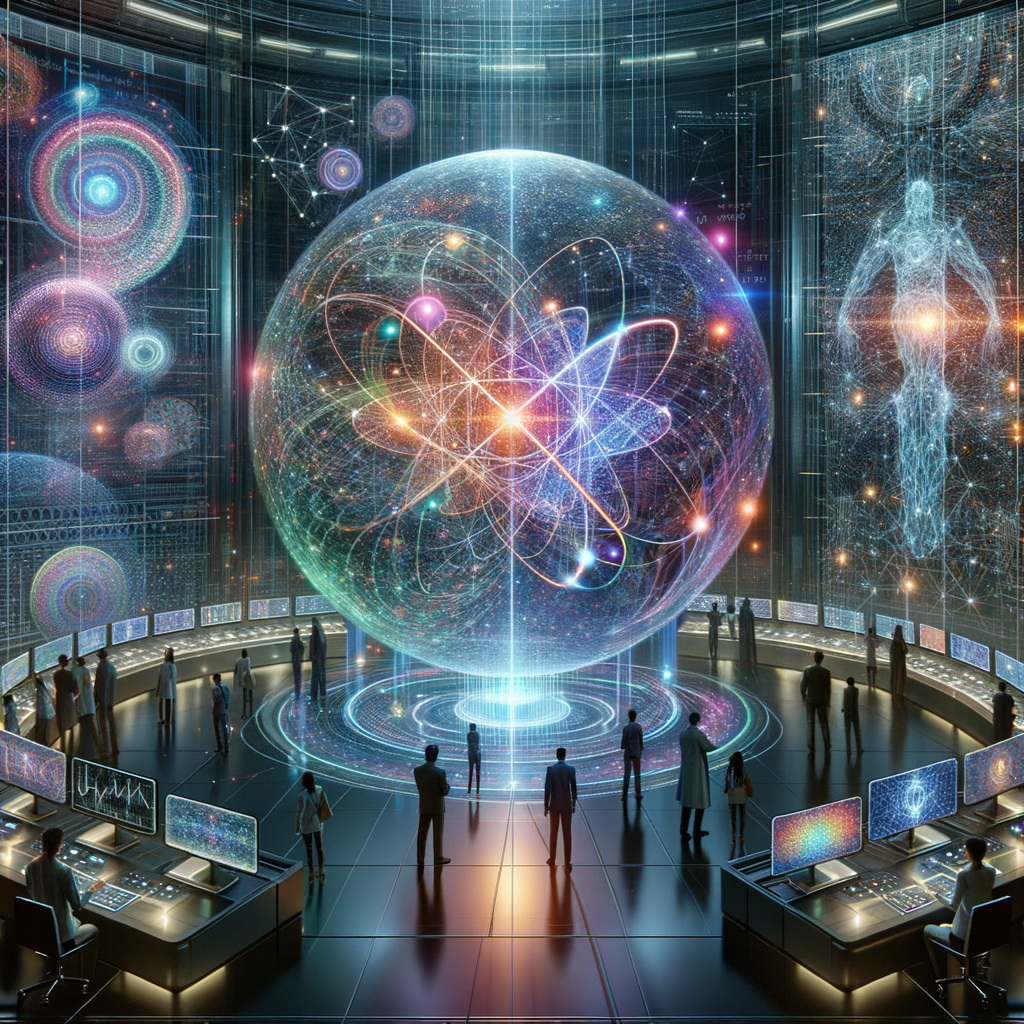
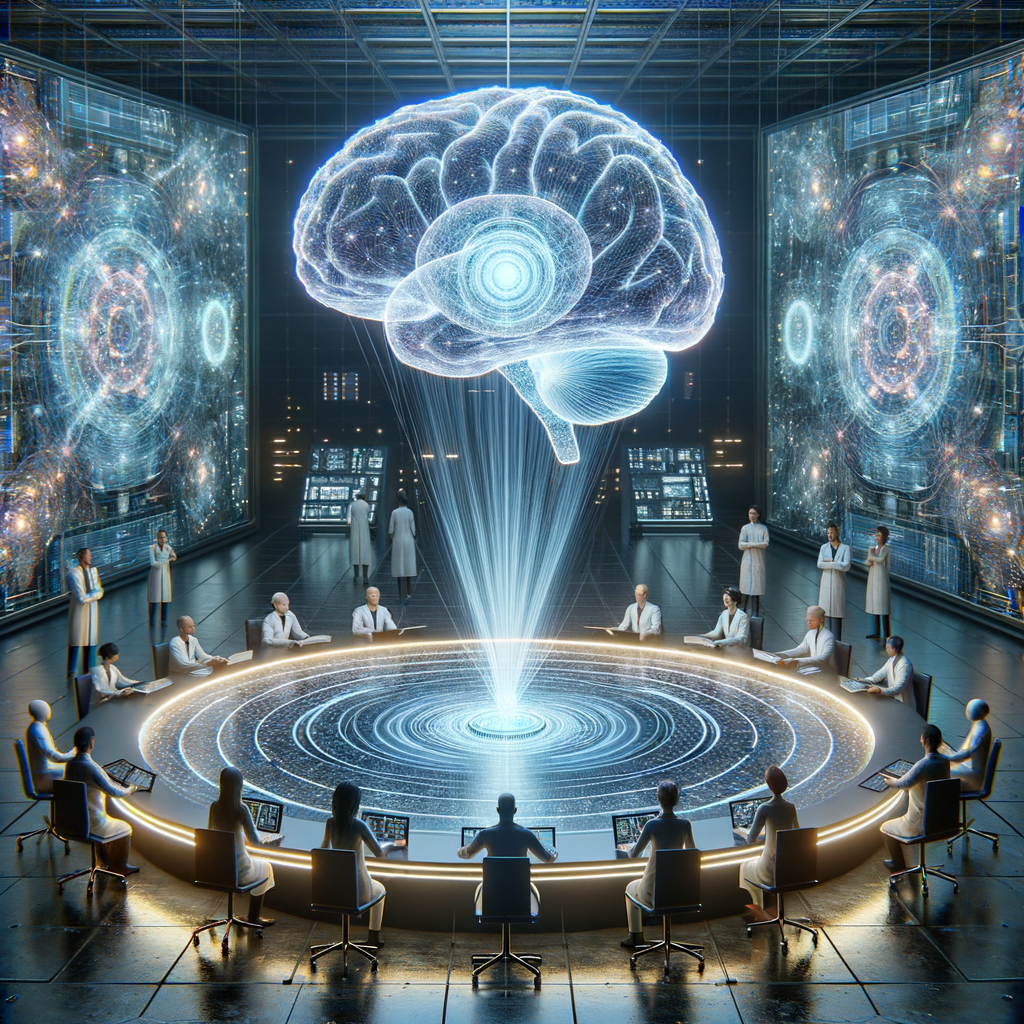
Quantum Holographic Artificial Intelligence (QHAI) represents a paradigm shift in computing, merging the enigmatic principles of quantum mechanics with the spatial intricacies of holography. The core of QHAI lies in the harnessing of superposition and entanglement to create multidimensional representation models, enabling AI systems to process and analyze data with unparalleled depth and complexity.
Harnessing the Infinite: Quantum Superposition and AI.
Quantum superposition allows quantum bits, or qubits, to exist in multiple states simultaneously. This plurality of states facilitates exponentially superior computational capabilities compared to traditional binary systems. By encoding holographic information into these qubits, QHAI can simulate cognitive processes at a virtually limitless scale.
def apply_superposition(qubit):
    # Quantum superposition implementation
    return qubit.coherence_factor * (state0 + state1)
Entangling Intelligences: The Role of Quantum Entanglement.
Quantum entanglement, referred to as 'spooky action at a distance' by Einstein, permits instantaneous interaction between entangled qubits regardless of the physical proximity. This underpins the synchronicity in QHAI systems, allowing for distributed intelligence networks that operate with exceptional coherence and speed.
def entangle_qubits(q1, q2):
    # Quantum entanglement process
    return q1 * q2
network = entangle_qubits(qubitA, qubitB)
The Holographic Canvas: Memory and Processing in QHAI.
Holography provides a framework for data storage and retrieval, utilizing interference patterns to create and manipulate 3D representations of information. These holographic storage systems in QHAI enable the simulation of complex neural processes, enhancing learning and adaptability in machine learning applications.
class HolographicMemory:
    def store(data):
        # Employ holographic storage technique
        return interfere(data)
Recent Advancements: Pushing Boundaries Beyond Classical AI.
Recent strides in quantum coherence stability and error correction algorithms have propelled QHAI from conceptual theory to tangible application. Breakthroughs at major laboratories worldwide have seen the development of decoherence-resistant qubits and more efficient error mitigation strategies, fortifying the viability of QHAI for real-world deployment.
Navigating the Quagmire: Challenges in Quantum Holographic AI.
The transition from a classical AI framework to QHAI introduces significant challenges, including qubit decoherence, the requirement for ultra-low temperature environments, and the intricacies of integrating quantum systems with classical architectures. Overcoming these hurdles necessitates innovative engineering solutions and interdisciplinary collaboration.
Future Horizons: The Untapped Potential of QHAI.
The future of QHAI points towards an era of unprecedented advancements in machine consciousness, cybersecurity, and environmental modeling. By further developing quantum holographic frameworks, AI systems stand on the precipice of advancing to uncharted territories, unlocking doors to applications we have yet to imagine.
Startup Struggles: Scaling QHAI Enterprises in an Evolving Market.
Navigating a quantum holographic AI startup amidst technological uncertainty poses fiscal and strategic challenges. Balancing rapid innovation with sustainability, securing investment amid volatile market valuations, and cultivating a workforce adept in cutting-edge quantum methodologies are critical to achieving enduring success.
Conclusion: Embracing the Quantum Holographic AI Renaissance.
Embracing the QHAI revolution requires a paradigm shift, not just in technology but in mindset, as we strive to transcend traditional barriers of computing. This transformative journey into the depths of intelligence promises to reshape industries, redefine possibilities, and ultimately, reshape our understanding of reality itself.