 © 2023 / 2024 - QHIQ
Navigating the Enigma of Quantic Holography in AI Evolution!
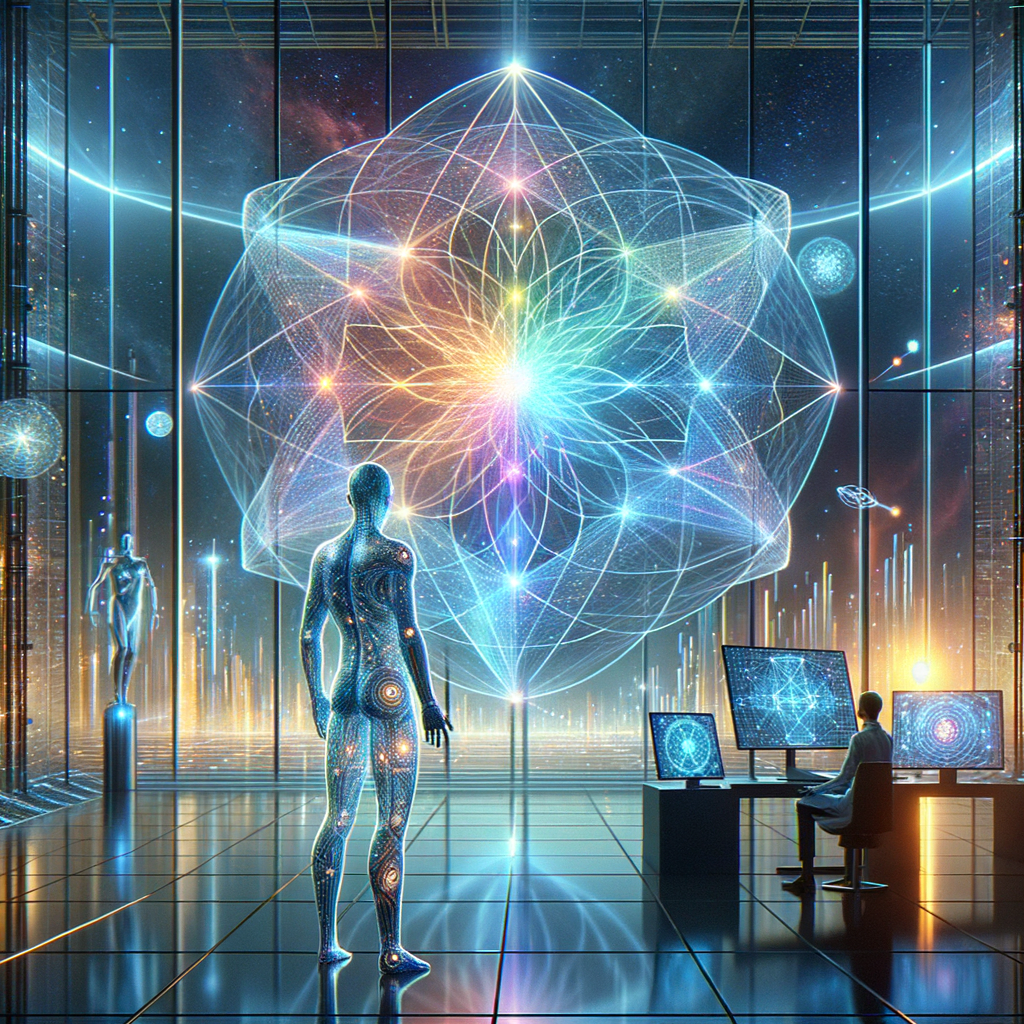
In the ever-expanding lexicon of artificial intelligence, the concept of quantic holographic artificial intelligence stands as a pivotal advancement, promising to recalibrate the boundaries of computational prowess. This marriage of quantum computing principles with holographic projections presents newer possibilities for data processing and simulation accuracy, opening avenues previously thought as science fiction. At Quantum Holographic IQ (QHIQ), we're at the forefront of this transformation, tirelessly working on intricate algorithms that leverage the depth and computing potential of quantic matrices to simulate and solve complex problems that classical algorithms grapple with. This ambitious foray necessitates significant innovations across both hardware architectures and algorithmic paradigms.
Revolutionizing Data Processing: The Convergence of Quantum Computation with Holography.
Quantic holographic AI, or QHAI, capitalizes on the unique characteristics of quantum superposition and entanglement, complemented with the spatial encoding capabilities of holography. This enables QHAI to process and store massive data sets with unparalleled efficiency, leveraging quantum bits (qubits) to occupy multiple states simultaneously, unlike the binary limitations of classical bits. By integrating holographic data encoding, QHAI surpasses conventional methods, which often suffer from bandwidth limitations and scalability challenges. These advancements present an opportunity to not only accelerate computational tasks but also exponentially increase the dimensionality and contextual richness of data analysis.
def simulate_quantic_holography(input_wavefunction):
    quantum_states = entangle(input_wavefunction)
    holographic_projection = encode_holographically(quantum_states)
    return process_and_analyze(holographic_projection)
The Driving Force: Quantum Processors as the Building Blocks for QHAI.
Central to the operational ethos of QHIQ's innovations is the use of quantum processors, designed meticulously to execute the superposition and entanglement operations that constitute the core of QHAI. Quantum processors enable the rendition of complex, high-dimensional QHAI paradigms which classical hardware cannot emulate, by employing high-fidelity qubit management alongside error-correction protocols. The implementation of gates—quantum mechanical equivalents to classical logic gates within a quantum circuit—enables the manipulation and transformation of qubits, laying the foundation for quantic holographic computations that could redefine sectors ranging from logistics optimization to stellar data modelling.
from quantum_circuit_lib import QuantumProcessor
quantum_processor = QuantumProcessor(qubits=256)
quantum_processor.apply_gates(['H', 'CNOT', 'MEASURE'])
The Challenges of Quantic Holography in AI: Navigating Uncharted Waters.
Despite its promise, the realization of QHAI is fraught with challenges that echo across technical, operational, and theoretical spectra. A chief concern remains the stability and fidelity of qubits over computational sessions, as decoherence and noise continue to plague quantum operations. Addressing these issues requires innovations in quantum error correction and a robust understanding of quantum entanglement that marries theoretical physics with practical engineering. Furthermore, constructing scalable infrastructures while maintaining the delicate balance of quantum states exacerbates the logistic complexity, demanding substantial investment in research and development.
Pioneering in Startups: The QHIQ Journey Through the Quantum Frontier.
At the heart of burgeoning technologies like QHAI lies the question of viable startup management amidst such dynamic landscapes. At QHIQ, we've amassed a collaborative environment that harmonizes cross-disciplinary expertise, fostering an ecosystem that not only catalyzes innovation but ensures it is sustainable and commercially viable. The challenge here pertains to balancing continuous R&D investments with revenue streams, while simultaneously navigating regulatory landscapes and securing intellectual property in fields so novel that legal precedents are minimal. Each milestone necessitates an alignment of strategic vision with tactical agility.
The Future Prospects of Quantic Holographic AI: Sculpting the Narrative of Intelligent Design.
As we venture into the future, QHAI stands to redefine industries, accelerating the evolution of AI systems from reactive processing tools to dynamic, predictive engines of change. The potential applications are vast, spanning personalized healthcare predictions powered by biomolecular simulations, to complex climate models capable of real-time adaptations. The onus now rests on industry pioneers to drive forward not just through technological innovation, but through ethical stewardship, ensuring that the implications of such advancements are responsibly managed to serve the collective human endeavor.